Showing posts with label RPG maker. Show all posts

Sunday, May 11, 2014

Wadanohara & The Great Blue Sea: A lovely trip to the deepest part of the sea

Art by Mogeko
Wadanohara and the Great Blue Sea is an RPG maker adventure game made by Deep Sea Prisoner (AKA Mogeko). It has horror elements, especially late in the game.

If you do not do well with gore or shocking scenes, you are going to have a bad time late in the game during a specific scene. Also, tw for sexual assault. Possible warning for what seemed to me like suicide in one of the endings (if it is, it's subtle, and definitely not graphic; you don't see or hear much). If you are here for a full discussion of the game, skip the technical stuff and scroll down.

Mogeko says this game is for all ages, and that may be true of the beginning but by late game it is more appropriate for older teens, maybe 14 or 15. The game is about 6-7 hours, definitely one of the longest RPG Maker games I have ever played.

The story of Wadanohara and the Great Blue Sea is that a young sea witch, Wadanohara, is returning to her home sea for the first time in a while. However, on her way home, she runs into an old friend, Samekichi, who repeatedly tries to fight her and her party of familiars to scare them off. Once she's home, she finds out from the princess that there have been attacks from another kingdom because someone has messed up the barrier meant to protect their kingdom and Wadanohara is the only one who can fix it. Along the way, Wadanohara and her familiars find out that appearances are deceiving and there is a traitor in their midst...

This game really surprised me. I meant to play The Gray Garden before this one but, after a bad day, I decided to give this one a shot since I knew nothing about it. It looked cute, so I thought it would be nice for stress relief. I didn't expect to fall in love with it, but I did. I have not had such strong affection for an RPG Maker game, or any game to be honest, since Ib. Yes, I think it is that good. I got sucked in and played for long periods. Once I was at the climax, I just blew right through to the end. 

Characters. First off, there are many female characters, which I always love and appreciate. Also, everyone is Japanese (they all have Japanese names). There are two characters who do not go by cis man or cis woman: Tarako and Sheep.

On Tarako, this is what vgperson had to say:
"Tarako, though, I initially thought was referred to as a boy in their bio, as it says おとこのこ. However, this is sneakier than it appears - it could be 男の子, boy, or 男の娘 - which I believe would make Tarako a trans girl."
I'll discuss Wadanohara's character in greater detail in my more spoilery thoughts on the game below, but although she is predominantly the "happy girl" character, she definitely has more depth than that, which I liked. Though, there's nothing wrong with having a character who is just happy, especially when bad things happen. I really liked Fukami's character. I liked that he was the only one to notice Wadanohara hide her true feelings and looked out for her the most. He has some of the best character development in the game, being selfish in the beginning, which you may not see until you look at the bonus scenes, but he has, in my opinion, evolved by the end of the game into a more selfless character.

Samekichi was kind of a cool character, I also liked to see how he "changed" by the end of the game. There was an element I did not like, and that was the "you're the only one I care about, Wadanohara" line. That type of line is usually for characters who are extremely possessive, which I'm not a fan of.  It's also a cliched line, but Samekichi was a good character overall.  Memoca was a cute character, I liked that she had different personality -- she was quick to anger, but playful and caring, and childlike. Chlomaki was a fun character, I enjoyed her interactions with her own familiar and I wish we had seen more of them. Unfortunately, Dolphi got the worst end of the deal. She didn't have much of a personality. I mean, she was a bit of a crybaby and scaredy cat but she shared too many traits with Memoca (caring, likes drawing, playful). There are way too many characters to discuss, but most of them left good impressions.

Gameplay is a pretty standard RPG Maker affair. Use the arrow keys to move, enter will interact with stuff, and the escape or x button will open the menu and such. This is an RPG Maker game with actual battle elements. But, as Vgperson notes on their website, the RPG elements definitely take a backseat to the story. The battles are not terribly difficult, and I never struggled with a regular enemy or boss. There are more than enough enemies for you to grind up on, but I made it to level 34 by end game and I was probably extremely overpowered.

Not much to say about graphics since I never know what a creator adds or just uses since I don't generally use RPG Maker. The sprites are, however, adorable. And Mogeko's art is always adorable and lovely. Throughout the game, as with, say, The Sandman made by Uri, there will interposed art during cut scenes, which is a nice touch. Even nicer is that some of them are animated. Generally, this is just a slight change in facial expression, but it is a nice touch nonetheless. One of my favorite things, graphic-wise, about the game was how looking in the mirror during different points in the game would result in different art of Wadanohara. Sometimes, it was just an outfit change, sometimes an expression change. I highly recommend doing it, especially during the gory scene late in the game...

Adorable. Art by Mogeko.
I do not believe Mogeko did any of the music themselves, but the choice of music is great. The title music is very recognizable, I'd probably rate it higher than Ib's. There is a nice variety of instruments and the music is always appropriate for the scene.

As far as replay value goes, there is not a whole lot. For beating the game, you will get to keep your levels and items in the new file but that is it. After beating the game, you will also have access to a bonus room with character bios, extra scenes, the art from the cutscenes, etc., I believe that is a norm for Mogeko's games. Also, for clearing the game, you will get a password you can use to open the Bonus file found in the game's folder. This will give you a url to view illustrations and comics; some spoil plot elements of the game and some don't. Vgperson translated the comics, so I'll put a link down below. There are different endings but you get them all in one go. You need not do anything special -- that is generally awarded for the bad endings. (There are 2 bad endings, and 3 normal endings... even if they seem more "bad" than "normal.") 

Now then, about the game's story. If you are familiar with the anime in question, you may know what I mean when I say this game definitely reminded me of Puella Magi Madoka Magica. It starts off as a cute, sort of slice of life (though, in Wadanohara's case, with a bit more magic) story with an adorable main character, then it gets dark. I think I like Wadanohara's story better, in this case, because it definitely has a happier ending (in the true end) than Madoka Magica did.

Wadanohara goes through quite a lot (I say that as an understatement) but she remains upbeat and hopeful throughout. I enjoyed that she was still, despite her being a sweet girl her predominant personality trait, a well rounded character. She had concerns and worries that she hid from everyone because she did not want them to worry.

I was also surprised to see who the traitor was. Mogeko really hid it well and did not give away any hints. Though, I don't know, perhaps you will get it your first time through! I have mixed feelings about Wadanohara's assault, however. Spoilers!

I think that it is important to have assault in stories -- when tastefully done -- because then no one is pretending such things never happen. They do happen with too much frequency, it's a fact of the real world. Every single one of Mogeko's games (Mogeko's Castle, Wadanohara, The Gray Garden) deal with assault in some matter, with Mogeko's Castle the most overt. I am a little wary that every single one of their games has assault, especially, in the case of The Gray Garden and Wadanohara, sweet little girls, but I will not pass judgement on that because I don't know anything about Mogeko, of course. It is interesting that each of the games take place in a fantasy setting where assault happens.

In Wadanohara's case specifically, I both like and dislike the way assault was handled. I dislike that the perpetrator basically got away with it (and it happens twice, as far as I can tell), and I dislike that you never get a real chance to take them down. I would say that I dislike that it basically happens because of a power struggle between two siblings, where the one who committed the assault wants to hurt their sibling by taking away/hurting the person they love (Wadanohara). I think it's somewhat realistic since assault and rape in the real world is about dominance and power, and it may not even be about the victim, so I do not hate it as much as I originally did. I also like that the effects for Wadanohara are realistic. She doesn't remember the assault (the game gives a reason for it that I don't love) and when she does remember, it is an extremely traumatic experience. That is when the goriest sequence of the game takes place. It's fitting that she isn't mysteriously okay with what happened; she has to work through it.

As I mentioned, it happens twice in the game. The first time, you'll be aware of it, but I believe it's more than fair to say that it takes place in the first ending, too. Again, it's traumatic -- so much so that Wadanohara ceases being who she once was, which is haunting.

I do have a bit of an issue with Wadanohara's age which is: I have no idea what her age is supposed to be. By the end of the game, she does look a bit older, her hair is much longer which would signify that she has aged, but I have no idea how old any of the male characters are and, considering the 3 main male characters have some type of feelings towards Wadanohara, it is a bit distressing, but that is all I will say about that.

I found the ending a little unsatisfying, mostly the final boss; I hoped that, at least in the true end, you would get the chance to do more with them. The true ending is really sweet, and I think that there is definitely some good character development happening in the game. At the same time, there were some things I could not get on board with, like a gameplay mechanic where one of the armor pieces is a ball gag. I know it is a joke, but considering that Wadanohara is likely underage and Memoca and Dolphi are both childlike, I found it in bad taste. Also, while there were many characters, it feels like a lot of them weren't fleshed out completely or their stories did not get told in too much detail. I liked the different story "arcs," if you will, but I do feel like the game was so focused on two of them that one of the most important plot points in the game -- the story of the two princesses -- suffered, which is a shame because I would have liked to see how that was resolved.

Overall, a great game with a compelling story. I fell in love with the main canon couple by the end. I hope that this game has a sequel, I think that it could be possible considering there are whole other worlds, including a witch one that is not shown much.

Plot: Wonderful. Fun characters and an interesting story.
Graphics: Pretty average, but I do like Mogeko's artwork in the cutscenes!
Sound/music: I thought the music fit the game and mood aptly.
Difficulty: A pretty easy game overall. I never lost to any enemies, but I did die in several of the chase scenes. Those can be challenging.
Ability to replay: Not much of an incentive there, unfortunately! You could, but nothing really changes. Though, if you miss the bad ends, that could be an incentive.
LGBTQIA+ Representation: Nothing overt. To be honest, there is a scene where Dolphi is scared and asks to hold Wadanohara's hand, and Memoca says something like "Aren't you clever?" so there could be a reading there for Memoca, but likely not. This is not like the Gray Garden. However, there are two characters whose genders are purposely unknown, which I would take to mean they do not conform to the gender binary, which I do like. Is it representation? I am not sure, and that is not my call.

Download the (English translation) game! 
Original site. You might want to check this out, there is some artwork and comics.
Translated comics. Contains spoilers for the game, check at your own risk!


Wednesday, October 30, 2013

The Witch's House: An RPG Maker game where curiosity kills the cat


The Witch's House is a free horror RPG maker game created by Fummy and translated into English by VGPerson. It was originally released last October and has recently received an update. I have decided to finish this review just in time for Halloween, which would be as good a time as any to play it in the dark with headphones.

This is one of my absolute favorite RPG Maker games and is, in fact, my second favorite. I do not want to say that it's "under appreciated" or anything like that, but I do think it is overlooked because, at its surface, it looks only like one big jumpscare game.  Not to say that the game does not rely on jumpscares to frighten the player because it does. However, there is definitely a story here, and it will slap you in the face by the end of the game. It is just that the story is not overt. 

The Witch's House is available only for PC (Windows version 2000, XP, Vista, or 7). I do not know if it works on Windows 8 as I use Windows 7 but feel free to leave a comment if you know!

A few technical things before I launch into the full review. This game is pretty gory as far as such things can be in RPG maker. Death scenes can be graphically violent (ex, you can get stabbed, lose your head, etc). For that reason, I recommend the player be maybe fourteen or so (although Fummy says twelve and up). Children should definitely not play this game.  As I already said, there are a LOT of jumpscares. If you are easily prone to being scared, or have any sort of heart condition, I do not recommend this game, as the scares can surprise you and the chase scenes can be very stressful. There is one point later in the game where the scares will keep coming and coming, and that is a definite point where, if you are faint of heart, you are going to have a bad time.

Allow me to admit that when The Witch's House was first translated (into English), I had pretty high expectations after playing through Ib. Ib was scary... sort of (the current version, which is different from the one I played a year ago, is scarier), but The Witch's House was a terrifying, heart-pounding adventure, full of jumpscares and surprises. The game also had a tendency to punish the player for following instinct and curiosity. What I've learned from the game is that if a puzzle seems simple, I have probably done it incorrectly. 

The controls are pretty straightforward, standard RPG maker fare. Arrow keys to move, escape key to access the menu (which allows you to use your items and even load from a save file, which is nice), shift to run (one of the most important controls in the game), enter to confirm or interact. Those are the basics, but there are a couple of alternate keys you can use for them as well (listed in the readme). If you have played a previous version of The Witch's House, your save files should carry over.

The story of The Witch's House… well, it is not very clear until the end and, even then, depending on how you play and which ending you get, you may not get the full effect. You awaken as a teenage girl named Viola in the middle of the forest. Viola slashes down a patch of roses and discovers herself in a strange house that tries to kill her. As you progress, you will find many diaries left by a girl named Ellen which hold some back story on the apparent owner of the house. Along the way, Viola is helped along by a black cat who will tell her very little. To escape the murderous house, Viola must find something to destroy the roses blocking her path out of the forest. She is left only with one clue, a note that reads, "Come to my room."

Let's discuss the characters of the game! The truth is, there are not many characters. There are only three main characters that are present in the game. Viola is the main and player character. She is a thirteen year old girl who gets lost in a forest on the way to see a friend. There is also The Cat who is a black cat that Viola meets in the forest. He follows her into the mysterious house and acts as a save point. He does not have a lot of dialogue. The final character is The Witch, who seems to own the mysterious house Viola unknowingly wanders into. You learn about The Witch through various diaries strewn about the house. 

The Witch's House is a puzzle based horror game, meaning that puzzles must be solved to progress (á la Ib). Every puzzle has notes on the walls that hint at what must be done to solve the puzzle. The puzzles in this game are unique and enjoyable. I love that the puzzle (and game) mechanics play with one's expectations. One of my favorite puzzles in the game is the mirror room puzzle, where you must mirror objects in two rooms (incidentally, Mad Father, another RPG maker game, ended up doing something similar). The solutions to some of the puzzles rely on cruelty and gore, which is why I put a warning at the beginning of the post. Make no mistake, these puzzles can be difficult, but a good difficult!

It is important to note that upon completing certain puzzles, the player will be chased by some type of creature, which must be evaded (usually by leaving or entering a new room). If, at any time, the creature catches Viola, it's game over. Chase scenes are usually hinted by a sound or an object changing (breaking, closing, etc.,) These chase scenes tend to be the reason why I classify the puzzles as difficult. Even if you know that they are coming, if you get stuck or something, you will have to restart from your last save point.

As I mentioned in the introduction, the game punishes the player for following instinct. The best example of this is the very first puzzle of the game. Spoilers for the first puzzle, highlight if you do not mind it being spoiled: There is a dark room with a stain in the center and a note on the north wall. During my first playthrough, I thought I could walk straight to the note and, as soon as I tried, the walls closed in and killed me. That was when I knew that I was going to love this game. I love how the puzzles are never as simple as they may seem. 

The difficulty of The Witch's House is somewhat difficult to place. I would say it is anything from average to difficult. For a first time player, it is going to be challenging because the chases can come as a surprise and cause instant death. For this reason, I recommend saving often during the first time playing. Solving a puzzle incorrectly can also sometimes be instant death. Using items incorrectly or using them period can, you guessed it, also cause instant death. There are many ways to die in this game is what I am saying, and if you do not know the triggers, then the game can be incredibly difficult. (Even if you do know the triggers, it is still pretty easy to die.)

The music used in The Witch’s House is very good, and I do like it a lot. The problem is, I think, that often the sounds fade into the background. There is a lot of good, atmospheric music, but it is not until I listen to the files separately that I realizes just how great everything is. Not to say there are no memorable songs in the game; there certainly are. The title theme, the music box song(s), and the piano music stuck with me the first time I heard them. The chase music is likewise excellent, it really gets your heart going and adds to the fear and anxiety of the situation.

The graphics in the original were not, in my opinion, too special. The original had a couple of unique animations but nothing terribly special. Fummy added a mess of new animations in 1.07 including door opening animations, object moving animations, and more. It is all subtle, but I think it adds a unique, cute factor that the game was previously lacking. The graphics have also been cleaned up a lot in 1.07, which I will go over in detail in a separate post, but the graphics are very clean looking. Some of the textures have also been switched out, for the better. One of my favorite examples:

The no-distraction hallway

Some very minor complaints I have are about the instructions, which I feel are a bit strange. In the opening of the game, the player does not find out the instructions until after walking around to get the first key item. By that point, the player would have had to figure out the controls. However, this problem is easily solved because the controls are listed in the Readme, which is important to read before playing a game anyway.  Very similar to this, the player can read a book in the library about how to open doors, which is a good idea but, by that point, the player would have had to know this already. I do admit that it could be a good thing to remember from that point onward, however. My complaints about the game, as you can see, are pretty minor. Not a lot sticks out to me as bad, and I clearly love a lot about this game.

I think this game also has a pretty high replay value. There is so much to see in this game, even just subtle changes. Things that I did not notice when I first played I found when replaying it recently. If you backtrack or explore an area after completing a puzzle, things will change and there will be different text. Be sure to explore at your own risk, however, as certain areas you return to may kill you. By backtracking after completing a puzzle, there are a lot of subtle changes, including subtle horror. One of my favorite "subtle scares" happens if you return to the mirror puzzle room later in the game and interact with the frog.

The The Witch’s House has about “four” different endings. Really, there are two real endings, a secret ending, and an "addendum."

  •     The first, or the easiest ending, is achieved by escaping from the house after the final "battle."
  •     The more difficult ending is the “true” ending where you must grab a secret item before escaping from the house. This changes the first ending dramatically and makes the entire game all the more horrifying in hindsight.
  •     The "addendum" to the endings is the most difficult to achieve. To get this ending, you must not save or talk to the black cat throughout the entire game with one exception. Slight spoilers in how to get this: In the no distractions hallway, if you  have not spoken to the black cat, you can talk to it here and look at the books, diaries, and notes which give the player much background information about the game and your player character.  This addendum really comes into play at the end of the game, right before the “final boss.” If you talk to the cat before this room, you gain even more knowledge about the cat, the house, and the player character. I do not recommend going for this addendum during your first play through unless you are very confident as you are not allowed to save and if you get killed at any point (easy enough to accomplish), you will have to restart the entire game.
  •     The newest ending that came to be in version 1.07 is such a secret that Fummy does not even acknowledge its existence. To get the ending, wait on the first screen without doing anything for an hour (the window must be your active window as well!) Ultimately, this ending is not, in my opinion, really worth it. I will be discussing it in detail in my post about the new version of the game. At its surface, it seems like a pointless ending, but once you examine the meta of it, it makes much more sense.

The Witch's House is not a long game; it takes about an hour or so to complete (of course, depending on how much you look around and not taking into account deaths and all) though Fummy estimates in the readme two to three hours, so I suppose it just depends on the player!

Over all, I would say The Witch's House is neutral on the feminist front. You do play as a female character, but you never interact with the other female character. In only one ending of the game does the game technically, in my opinion, pass the Bechdel Test. I suppose in most instances of the game, it does sort of pass the Bechdel Test, but only in one ending is it obvious. Major spoilers for the game: You actually do interact with the other female character, Ellen, in the true ending (the stuff that happens in the bedroom is not really interacting) but it is not positive, and the relationship is not a good one. Ellen taunts Viola, but... I wouldn't say this takes away from whether or not the game is feminist friendly, to be honest. It is difficult to say if there is any queer representation because there is no romantic subplot. I will not make a call on racial representation, and here is why. I try not to ever, as a white person, make calls on anime/manga character. For more reading on this subject, I recommend this article.


The game is definitely not anti-feminist, and I do love that you get to play as a female character because that feels like such a rare opportunity still in this day and age, but it does not do much that makes it feminist. However, I think it is a safe choice for any feminists or anyone who is concerned about offensive content (I mean, there is the whole cruelty and death stuff, but).

Overall, I would rate the game about a 3.5. Here's the final breakdown:
Plot: Four stars. I love the story and the characters, but most of the story is subtle and does not come into play until the end of the game.
Graphics: Three and a half, I suppose. Nothing too special. There are some unique animations.
Sound/music: Three. Not a whole lot of variety in the songs and the songs tend to sort of fade into the background in most cases.
Difficulty: Probably about a four. The game can be incredibly difficult, especially when going for the no-save "addendum" ending.
Ability to replay: Three. You probably only need to replay the game twice to achieve all of the endings. There are a lot of subtle details to witness, but those don't necessarily require replaying the game, especially if you are not interested in such things.

I do truly love and enjoy this game. It is certainly my second favorite RPG maker game for its unique (horrifying) puzzles, story, and over all gameplay mechanics. I think it is a really strong game and the "true" ending is one of the best endings I have ever seen in any video game.

You can download the English version of The Witch's House here.

The original (Japanese) website is here. If you go to this website, you'll see that Fummy is going to be releasing a book based on Ellen's story, a prequel to The Witch's House.

Friday, October 4, 2013

The Witch's House 1.07 is now out!

A week ago, VGPerson (translator of Ib, The Crooked Man, Mad Father, etc.,) announced on her tumblr that, after a year, Fummy has updated The Witch's House. 

The most notable aspect of this new version is a new, obscure ending. From VGPerson's tumblr:
Notable changes:
- Many of the area tiles and some other graphics are redone.
- Viola has little animations for just about everything now - opening doors, grabbing items, pushing things, etc.
- Some chases are allegedly easier, but it all seems about the same to me.
- The room with the woman statue was changed very slightly, but it all works out the same way.
- The poison room has the bottle and the Skull Soldier book out in the open, rather than hidden in shelves.
- Fummy removed the number lock puzzle several versions ago, but I finally complied with that change, since… I dunno, it was more annoying not to.
- I made some very minor translation fixes and changes.
Apparently, the new ending is not easy to find, to the point that even Fummy has not made note of it in the readme to make it even more obscure! I am very excited; The Witch's House is my second favorite RPG Maker game (which, I believe, I have made note of in the past) and if you have not played it before, I highly recommend playing it now.

In fact, it's a perfect game for October!

I plan to play through it tonight and write a review at some point in the next week. Stay tuned!

You can download The Witch's House here.

Friday, April 5, 2013

The final Ib version 1.05 is out!

As the title says, Kouri has updated Ib for what he says is the final time.

I haven't downloaded it quite yet, but here is what VG, the English translator of Ib, had to say about the changes:

It’s really just a bunch of bugfixes, though. Nothing to get excited about. Also, saves from 1.04 will work.
Changes:
- Garry won’t comment on the Liars’ Room unless you actually do it.
- You can no longer save as solo Mary, since you’re locked onto an ending you can’t continue from.
- When on a second playthrough, the portraits for the save files have a + in the corner. For old saves, this will only take effect when Ib, Garry, and Mary first join (Ib “joining” when you get an ending).
- The new dungeon is a little easier; there are more vases (one at the start, and a second in Abyssal Park… if Garry’s dead), and the croquis room has one less red guy and no stools to get in the way.
- There are pamphlets in the true exhibition explaining New Game Plus and stuff.
- The music list in the true gallery is fancier-looking now.
- Some things that got left out of the true gallery were added, including a very special guest.
Lastly, kouri confirmed he has no plans for any further updates.
On a final note, sorry I have yet to update this blog, folks! I recently injured my wrist, so I have not been able to completely check out Ib 1.04. I've done quite a bit, though, and I like what I see! I only have two more endings to go until I feel confident in my ability to discuss it completely.

Once again, the game can be downloaded from here.

Ib is also now available to download for the Mac! If you have a Mac and would like to play the game, visit the link I posted and go down to where it says "Mac."

Other things to look forward to, I'll probably be doing a series of playthroughs for a few more horror RPG games, like The Witch's House, Mad Father, The Crooked Man (all of these have been translated by VG as well), but I won't be doing so for another month, probably, but look out for my reviews on them nonetheless!

Thursday, March 21, 2013

Ib Version 1.04 is out now!


As you all know, I am hopelessly obsessed with the freeware game Ib for RPG Maker.

Since the end of last year, Kouri (creator of Ib) has been promising a significant update to the game, and he finally finished it!

VG has it all translated and ready to go if you want to download it from here.

Why would you want to download the game, you ask? A few reasons, detailed from VG's tumblr:
"I may post a complete list of changes later, but here are the big ones:
- The music is compressed, so the filesize is smaller. (About time.)
- There are new paintings and conversations to find in old areas.
- A new branch is available that leads to two new endings.
- After any good ending (read: Ib escapes), you can start the game over, keeping track of your endings and such.
- After you beat the game once and continue as mentioned above, a new dungeon becomes accessible in the final area."
I'll write an updated post once I've played the new version to its depths, but it is quite safe to say that Ib's replaying ability has just gone up even more.

Wednesday, September 12, 2012

Ib, an RPG Maker masterpiece

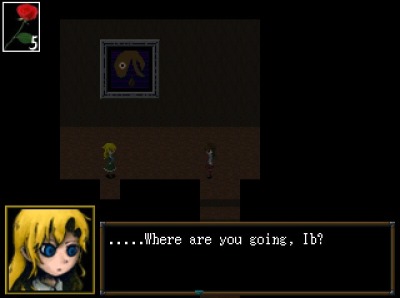
A screen shot from the beginning of the game.
Before I created this blog and was only sitting on the idea, I knew that I had to write about Ib. I fell in so much love with the game that I had to share its existence with other gaming friends; it's that kind of game. I wasn't sure how long I should hold off on posting about it, but this game is fantastic, and everyone ought to know about it.

Ib is a free (yes, free!) RPG maker horror game by Kouri that was released February of this year. I think it would be fair to categorize it as a puzzle game as well since puzzles are a necessary component to progressing in the game. If you're not a puzzle person, don't allow that to deter you. The puzzles aren't too difficult, and the game itself is a lot of fun.

Ib is about a young girl, named Ib (pronounced "Eve"), who visits an art museum that is holding a special exhibit for a lesser known artist, Guertena. After looking at a particular, large painting, Ib finds herself alone in the museum and soon finds herself in another world after descending into a painting. When she goes to turn back, the exit has disappeared, and Ib traverses the new world in hopes of escape, along the way meeting allies and enemies.

As I mentioned, the game isn't that difficult. Most of the puzzles can be figured out with logic, or, even, trial and error. There was only one puzzle in the entire game that I had trouble with. I felt so embarrassed afterwards because the solution was so simple and logical. The puzzles are unique and interesting, and often require interacting with the paintings of the "fabricated" world. One of my favorite puzzles was "The Liar's Room" which requires Ib to find out which portrait is lying to her. Once you pick the right one, something decidedly eerie happens...

With regard to gameplay, it's pretty straight forward. You play primarily as Ib. The arrow keys allow the player to navigate, pressing enter/space allows the player to examine things or speak to other characters. Ib's health is represented by the red rose found in the fabricated world. She has 5 HP, then it's game over. As the game says: "When the rose wilts, so too will you wilt away." While there is no fighting in the game, which may make you curious about the need for HP, there are many enemies. Much in the vein of Amnesia: The Dark Descent, you'll need to run away from enemies since there is no way to fight them.

The graphics of Ib are interesting. Perhaps not groundbreaking, but good all the same. The designs of the enemies are cool, the portraits (while artwork sometimes repeats itself, there are many different paintings to look at) are lovely, and the design of certain rooms is just plain awesome, especially if you revisit the same room as a different character. The graphics change dramatically at the end of the game, when Ib proceeds from the alternate museum to a new area called the Sketchbook which, as you might guess, looks like a child's sketchbook. The dramatic shift in graphics compliments the change in atmosphere by that point in the game.

The music is wonderfully and artfully done. The theme for the Sketchbook suits the game's change in atmospheres. Hide and Seek is arguably the game's most beautiful and saddest-sounding song. Another claim to fame for this game is the characters. While Ib herself is more a silent protagonist (think Link from The Legend of Zelda series, though you can sometimes choose Ib's responses during cut scenes) and most of her emotions are shown through the other characters, Garry and Mary are three-dimensional characters. They are interesting, and they both have very clear personalities. An all important factor in the game is Ib's relationships with other characters. It is especially vital to the plot.

A fun mechanic of the game is seeing how the player's actions cause things to happen. As I mentioned, choosing the correct portrait in "The Liars Room" puzzle causes things to change. You'll find this often happens as you work on puzzles and progress through the game. It's very interactive in that way.

This game can be replayed again and again because of it's sheer number of endings; there are six in all. In order to get certain ones, you have to do certain things (things one might not consider while playing the game), not do certain things, or, even, do nothing specific at all. There are also unique events that you may miss out on the first time playing. (For example, I played at the same time as a friend, I got an extra scene that she did not, likely because I spoke to a particular character more, or what have you.)

Ib isn't so short that it leaves the player longing for more (though, depending on how invested you are in the characters, you may feel this way nonetheless), nor is it so long that it just seems to drag. It has a nice, solid length that will keep you interested while playing.

Don't forget that this game is a horror game. There are some very dark moments (e.g. "The Liars Room" puzzle), some very violent (albeit cartoon violence) moments, and there can also be some genuinely frightening moments (though it depends on the player) during chases and more.

I could go on and on about my views of Ib and how much I adore it. For a free game made on RPG Maker, it's breath-taking, and it has spurred quite a following. As clichéd as it sounds, Ib is an experience, one I would almost definitely pay an obscene amount of money for.

Over all, I would probably rate Ib a four, broken down as such:
Plot: Easily five stars. Great characters, great endings, great story.
Graphics: Four. Nothing to get too excited about, but still great.
Sound/music: Four. Again, nothing amazing, though there are some very great themes.
Difficulty: It's not that difficult, so I would rate it a three in terms of difficult. Don't let that turn you away. The game's mediocre difficulty level means that gamers (and non-gamers) of all walks of life can play it.
Ability to replay: 4 for the number of endings alone.

Here is the original website. It's in Japanese, so I doubt most of my readers can read it, but I feel that the creator should get credit. There's also an image gallery on here, which is pretty cool.

Here is the translated website. It has the download link for Ib, so you should definitely play it. There's no reason not to, as I already mentioned, it's free! The translator was kind enough to include a guide for the endings.

If you have a PC, go ahead and download the game! It's a great experience, no matter what and, most of all, it's free, so if you don't like it, you don't have to pay for it. If you don't have a PC, there are plenty of Let's Plays on Youtube. Certainly, if you do play it or have already played it, be sure to let me know in the comments.